How to Start a Themed Pokémon Card Collection
Published on March 1, 2026
Former coffee shop owner and Level 4 TCGPlayer seller collecting every Pokémon card with a beverage in its artwork. More about me
Most people collect Pokémon cards one of two ways: they chase the most valuable cards, or they try to complete sets. Both are fine, but there's a third approach that I think is more fun and more personal — themed collecting. You pick a subject, an idea, or an aesthetic, and you hunt for every card that fits it.
I collect cards with beverages in the art. Coffee cups, teapots, kettles, matcha — if there's a drinkable liquid in the illustration, I want it. It's specific enough to be interesting but broad enough that I keep finding new cards. Here's how to build your own themed collection, using beverage cards as the example throughout.
Choosing a Theme
The best themes share a few qualities:
Specific enough to be coherent. "Cards I think are pretty" isn't a theme. "Cards where Pokémon are eating food" is. "Cards featuring outdoor cafés" is even better.
Broad enough to actually collect. If your theme only has three cards in existence, you'll finish in a week and have nothing to hunt for. My beverage theme currently spans 90 cards across dozens of sets — plenty to keep me busy.
Personally meaningful. You'll be searching through thousands of card images. Pick something you actually care about. I'm a coffee person; the collection reflects that.
Some other theme ideas I've seen collectors pursue: cards with books or reading, Pokémon sleeping, rainy scenes, food and cooking, musical instruments, night sky artwork, cards featuring specific color palettes. The Pokémon TCG has such a massive catalog of illustrations that almost any visual theme will yield results.
Finding Cards That Fit Your Theme
This is the hardest part, and honestly the most fun. There's no master database of "Pokémon cards with coffee in them" (well, there is now — that's PokéBrewdex). For most themes, you'll need to do your own research.
Method 1: Browse Set Galleries
Sites like PokémonTCG.io and Pokéllector let you browse every card in a set. This is slow but thorough. I'd recommend starting with modern sets (Scarlet & Violet era forward) since the Illustration Rare and Special Illustration Rare cards tend to have the most detailed, scene-based artwork where thematic elements show up.
For my collection, sets like Twilight Masquerade and Brilliant Stars were goldmines. Others had just one or two relevant cards. You won't know until you look.
Method 2: Search by Pokémon Species
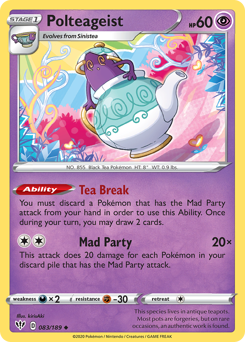
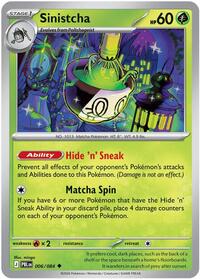
Some Pokémon are theme-relevant by nature. For beverages, that means Sinistea (a teacup), Polteageist (a teapot), Poltchageist (matcha), and Sinistcha (matcha evolved). Once you identify the obvious candidates, search for every printing — you'll often find more variants than you expected. Polteageist from Darkness Ablaze alone has five different variants.
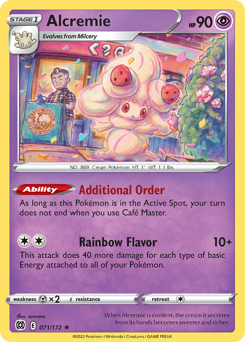
Other species that are less obvious but fit my theme: Alcremie (cream-based Pokémon — appears in four different sets in my collection), Ludicolo from Detective Pikachu, and Slurpuff which has sweets and beverage associations.
Method 3: Search by Trainer/Supporter Cards
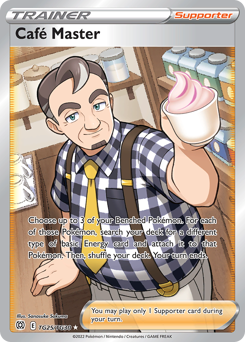
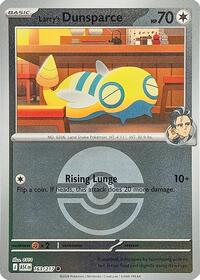
Don't overlook Trainer and Supporter cards. Cafe Master is literally a barista card. Salvatore, Larry, and various Professor cards feature characters in settings with beverages. The Special Illustration Rare versions of Trainers (Iono, Grusha, Arven) often have the most detailed scene artwork.
Method 4: Community Knowledge
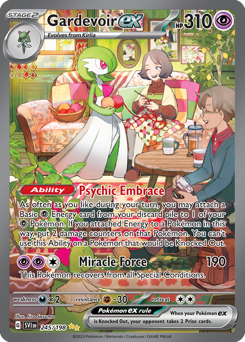
Reddit, Discord servers, and collector forums are full of people who notice obscure details. Posting "what Pokémon cards have X in the artwork?" will usually get you answers you'd never find on your own. I discovered several cards in my collection this way — things like the Gardevoir from Astral Radiance TG which has a coffee cup next to a computer in the background. You'd miss that skimming through a set gallery at speed.
Tracking Your Collection
Once you've identified target cards, you need a system for tracking what you own and what you're still looking for. A few approaches:
Spreadsheets
A Google Sheet or Excel file is the simplest option. Columns for card name, set, card number, variants you need, variants you own, and where you bought it. This is what I started with before building PokéBrewdex. It works, but it's not pretty and you have to manage it manually.
Collection Apps
Apps like TCGPlayer's collection tracker let you scan cards with your phone camera and track ownership. The downside is they're organized by set, not by theme, so you'll still need a separate list of which cards fit your theme. They're great for value tracking, though.
Build a Dedicated Tracker
This is the overkill option, and naturally it's what I did. PokéBrewdex is a purpose-built site for tracking beverage-themed cards with variant tracking, beverage notes, and set information. Is building an entire web app necessary? No. Was it fun? Extremely.
Buying Singles vs. Opening Packs
Let me be direct: if you're collecting around a specific theme, buying singles will save you money. The math doesn't work in your favor when you're hunting for specific cards through sealed product. A Common card costs $0.10-0.25 as a single. Pulling it from a pack costs you $4+ per pack with no guarantee.
That said, there are reasons to open packs too:
It's fun. The dopamine hit of pulling a card you need is real.
You find cards you didn't know about. I've discovered several beverage-themed cards by opening packs and going "wait, is that a coffee cup?"
Trick or Trade seasonal packs are great value for themed collectors — they're stamped holofoil versions of commons and uncommons at a low price point
My approach: I buy singles for anything above $2, and I open packs for fun with the understanding that any themed cards I pull are a bonus, not the primary goal.
Storage and Protection
Themed collections deserve proper storage. Here's the hierarchy:
Penny Sleeves + Toploaders
The baseline. Every card should at minimum go in a penny sleeve (the thin, clear plastic ones that cost about a cent each). Cards worth more than a couple dollars should get a toploader too — the rigid plastic cases that prevent bending. A pack of 100 toploaders costs around $8-10.
Binder Pages
For display and browsing, a binder with 9-pocket pages is ideal. This is where themed collections really shine — you can organize by set, by Pokémon, by variant, or by whatever grouping makes your theme look best. I use a separate binder just for beverage cards, with the Sinistea/Polteageist family getting their own spread. Ultra Pro and VaultX both make good-quality binders with side-loading pockets that keep cards from falling out.
One-Touch Cases
For your premium cards — SIRs, shiny vault cards, anything over $20 or so — magnetic one-touch cases are worth it. They're more expensive ($2-5 each) but they provide rigid protection and look great on a shelf. I keep my Sinistcha ex SIR in a one-touch.
Growing Your Collection Over Time
A themed collection is never really "done." New sets come out every few months, and each one might contain cards that fit your theme. Set up alerts or check spoilers when new sets are announced — you'll want to know early if there's a card with a coffee cup in the background of the 37th rare.
Here's what's worked for me:
Check new set spoilers as they're revealed. Card images get leaked or officially previewed weeks before release. Flag anything that might fit.
Buy relevant singles during the first few weeks. Prices on non-chase cards are usually lowest right after a set drops because supply is high.
Revisit older sets periodically. You'll miss things the first time through. I keep finding cards I overlooked — someone recently pointed out the Herdier from White Flare which has a kettle and cup on a coffee table.
Keep your tracker updated. Whether it's a spreadsheet or a dedicated app, update it when you acquire cards. Future-you will thank present-you.
Why Themed Collecting is Worth It
The Pokémon TCG market is dominated by chasing expensive cards, grading scores, and investment talk. Themed collecting is the antidote. You're not competing with investors for the next $500 Charizard. You're finding the $0.25 common where an illustrator decided to draw a teapot in the background, and that feels like discovering a secret.
My collection of 90 beverage-themed cards spans decades of Pokémon history, from Aquapolis in 2003 to Destined Rivals in 2025. Some of these cards are worth real money; most of them aren't. All of them tell a story about how different illustrators saw the same brief — "draw a Pokémon in a cozy setting" — and decided a hot drink belonged in the scene.
If that sounds appealing, explore the full PokéBrewdex collection to see what a themed collection looks like in practice. And check out my deep dive into Sinistea and Polteageist cards or my set-by-set breakdown if you need inspiration to start.